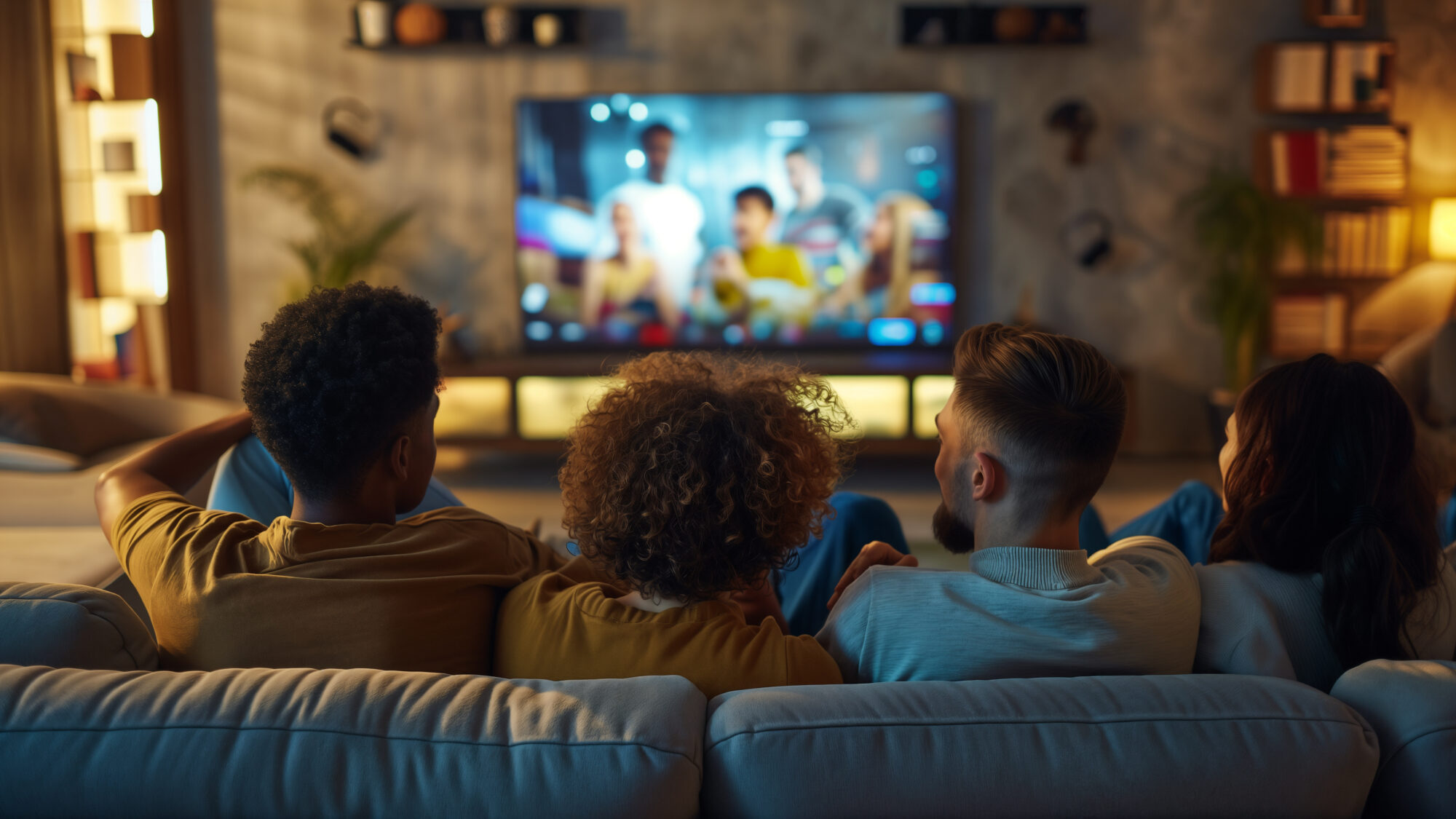
When furnishing or reorganizing a living room, choosing the right distance between the sofa and the TV can raise several doubts. Sitting too close can strain the eyes, while sitting too far away can make you lose image detail.
In reality, the answer depends on several variables: screen size, TV technology, and the layout of the room. In this guide, we’ve summarized the latest technical criteria for calculating the optimal viewing distance, along with practical tips to adapt them to your space. We also explore an often overlooked aspect: how the choice of sofa – its depth, configuration, and even its dimensions – can directly influence your everyday viewing experience.
Debunking a myth: no eye damage from sitting close to the screen
For decades, it was believed that sitting too close to the television could harm your eyesight. This assumption led many people to move their sofas farther back or choose smaller screens than necessary. The American Academy of Ophthalmology has clarified that watching a screen from a short distance does not cause permanent damage to the eyes, in either children or adults. (Source: American Academy of Ophthalmology, “Computers, Digital Devices and Eye Strain”) The discomfort experienced after prolonged viewing—such as dry eyes, heaviness, or headaches—is actually due to eye strain, which depends on the duration of screen exposure rather than the viewing distance itself.
That said, positioning the sofa correctly relative to the TV remains essential to achieve the best visual quality and maintain a comfortable posture without effort.
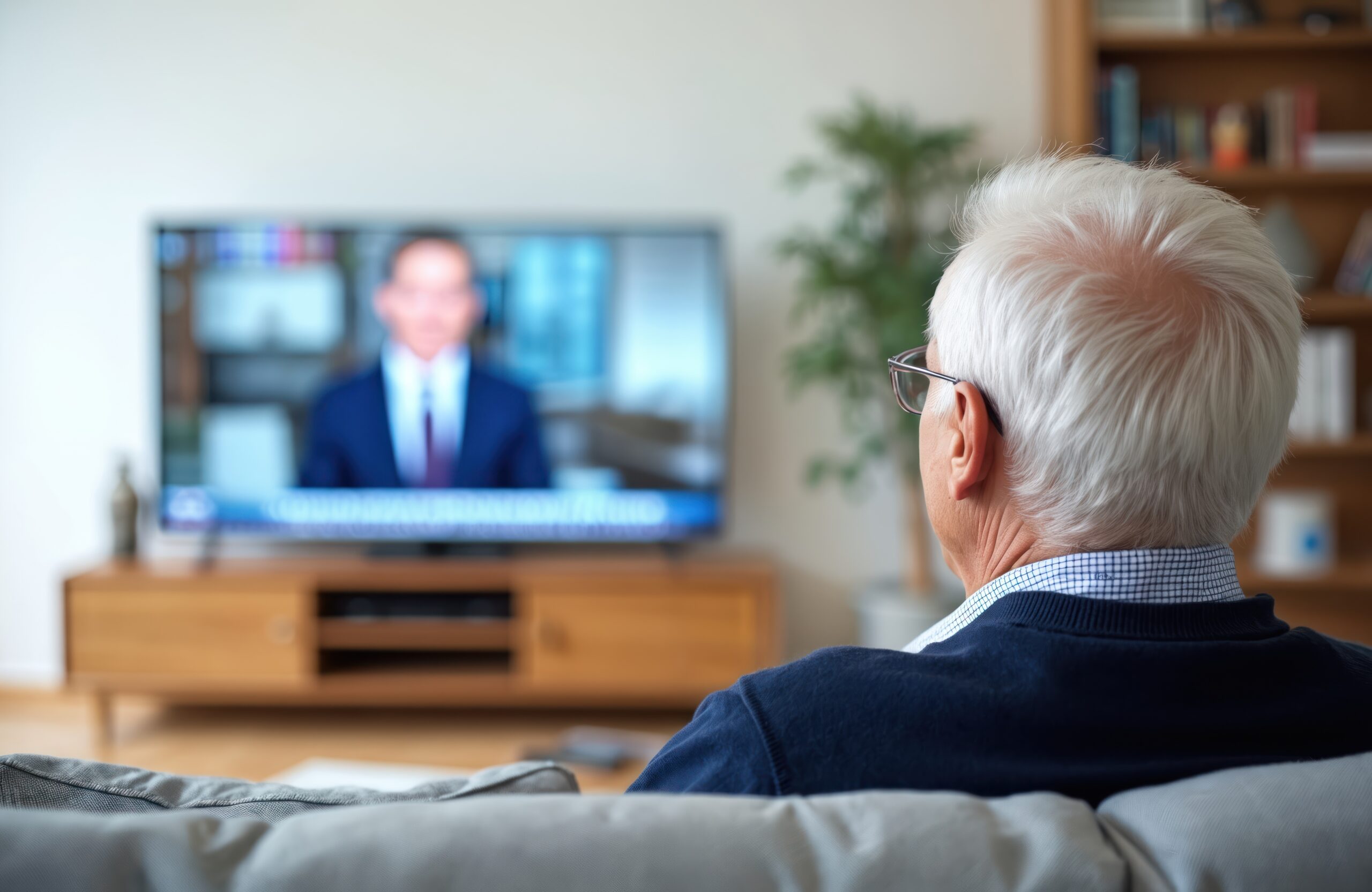
How to calculate the right distance between sofa and TV
The old rule of sitting at a distance equal to three times the screen’s diagonal dates back to cathode-ray tube TVs and early LCDs. With those models, sitting too close made individual pixels visible, reducing image quality. With modern 4K TVs, this concept is outdated. Their much higher resolution ensures a sharp image even at shorter distances without straining the eyes. Sitting too far away, on the other hand, means missing out on much of the detail the screen can deliver.
As a practical guideline, the following ratios are generally used today:
- Full HD TV: distance ≈ 2.5 × screen diagonal
- 4K TV: distance ≈ 1.5–1.8 × screen diagonal
- 8K TV: distance ≈ 0.6 × screen diagonal (very close, often impractical in real living rooms)
For the most common screen sizes:
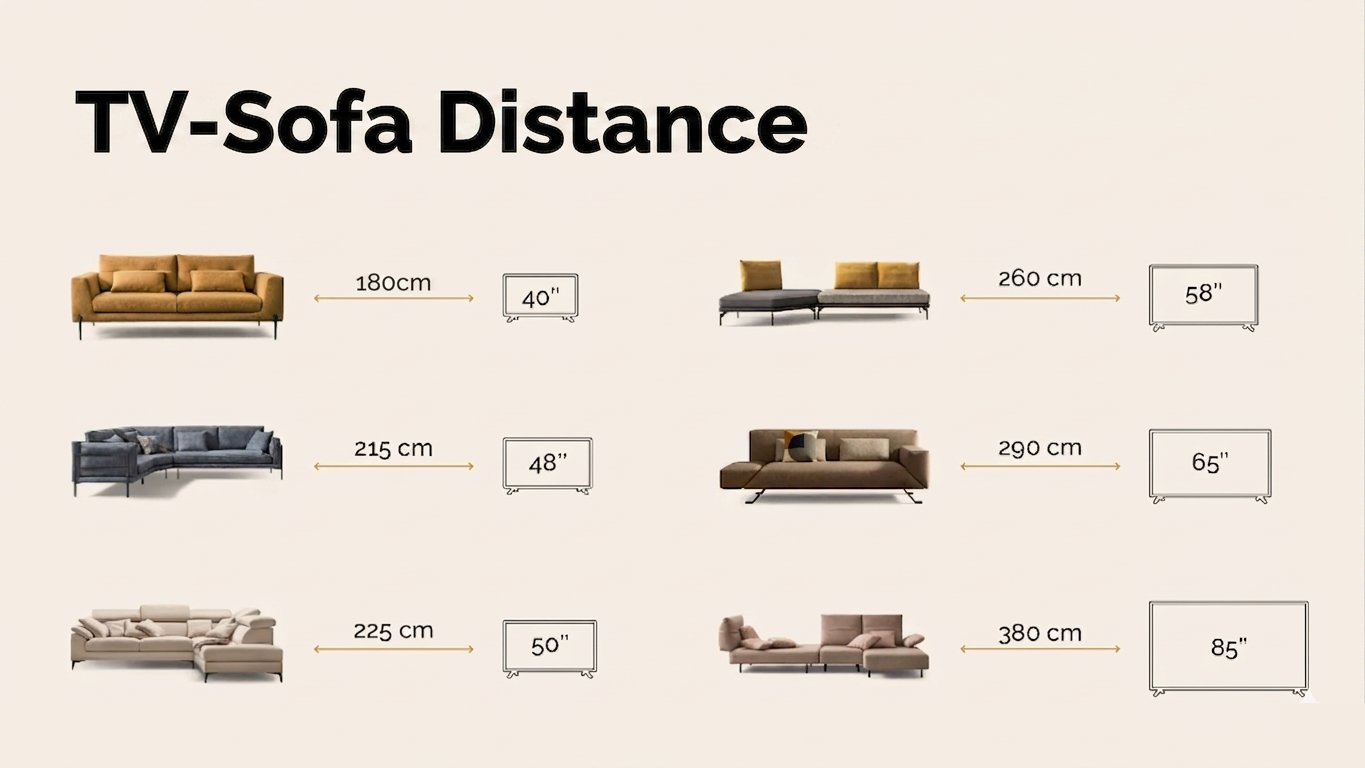
- 55″ 4K TV: recommended distance between 2.4 and 2.7 meters
- 65″ 4K TV: recommended distance between 2.8 and 3.1 meters
- 75″ 4K TV: recommended distance between 3.2 and 3.6 meters
Those who arranged their living room based on older guidelines can now move noticeably closer to the TV and often enjoy a more immersive experience.
Personal preferences still apply. People who mainly watch movies and TV series tend to prefer a closer, more immersive view, while sports enthusiasts often favor a slightly greater distance to keep the entire scene in view without constantly moving their eyes.
At what height should the TV be positioned?
The center of the screen should be at eye level when seated, typically around 100–110 cm (39–43 inches) from the floor. Mounting the TV too high – often for aesthetic reasons – can lead to neck strain over time. If the TV position is fixed and cannot be adjusted, a sofa with reclining backrests or adjustable headrests can compensate. Even a slight tilt reduces neck strain during extended viewing sessions. A practical example is Space Action (Relax collection), where adjustable headrests allow you to find the ideal head position regardless of the TV height.

Space Action sofa with adjustable headrests and removable seats.
Why the backrest position matters
When calculating the distance between sofa and TV, people often measure from the sofa to the wall. However, the real variable is the position of the backrest. When seated, it is your back—and therefore your head position – that determines how far you are from the screen. A more reclined backrest increases the distance, while a more upright one reduces it. This creates a measurable difference. Some Samoa models are designed precisely with this in mind. Astor (Divine collection) features a mechanism that allows significant forward and backward movement of the backrest. The same feature is found in most Divine collection models, including Pull, Sound Fly, Boss, and Avalon.
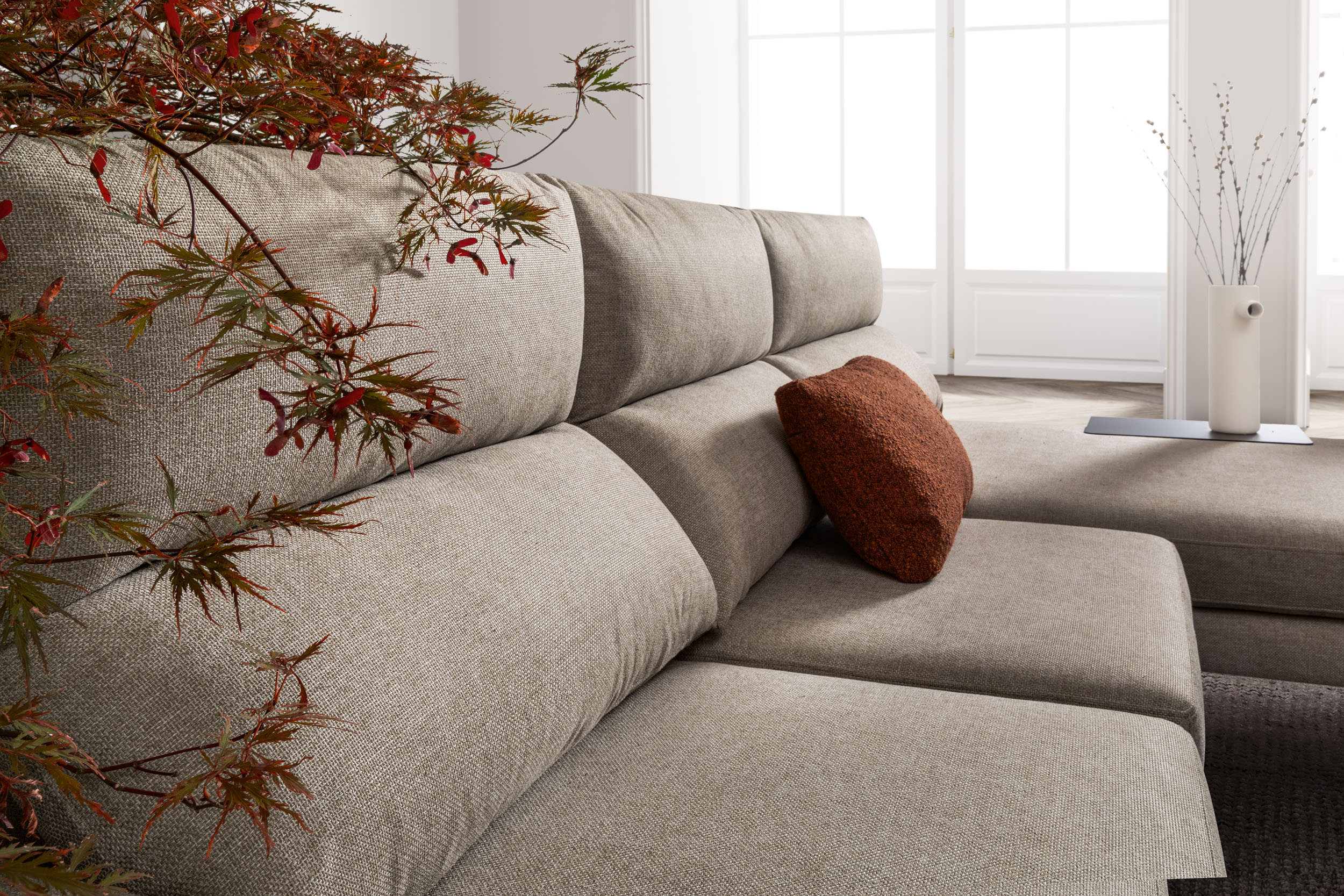
Astor sofa with sliding backrests.
Jest and Matrix (Divine collection) also offer adjustable backrest positions through their dedicated backrest packages.
For even more advanced comfort, Swing Slick (Relax collection) adds the enveloping feel of a supportive backrest, with an optional relaxation system.

Jest Special sofa, which offers optional features such as movable backrests, large seats and relaxation solutions.
Swing Slick sofa with extractable seats and enveloping backrest that supports with ergonomics and softness.
Sofa-TV distance, room layout, and light: three factors to consider together
In Italian homes, the distance between sofa and wall typically ranges from 2 to 3 meters. With updated 4K guidelines, this range works well with 55″ or 65″ TVs—the most suitable sizes for the majority of spaces. However, the layout of the living room often introduces practical constraints.
- Narrow and Long Living Rooms. The TV is placed at a fixed distance that may not be ideal. It’s advisable to consider a slightly smaller screen and avoid placing the sofa directly against the back wall. If space is limited, choosing the right sofa becomes even more crucial: we’ve put together some useful strategies in this article: Small rooms: space-saving strategies and design ideas.
- Square or Large Living Rooms. There is a temptation to choose a very large TV. However, even with 4K, an 85″ screen viewed from 2 meters can become visually tiring. It’s best to balance proportions. Models like Isla (Experience collection), with freely positionable backrests and armrests and goose-down cushions, allow you to create a tailored layout without compromising visual comfort.
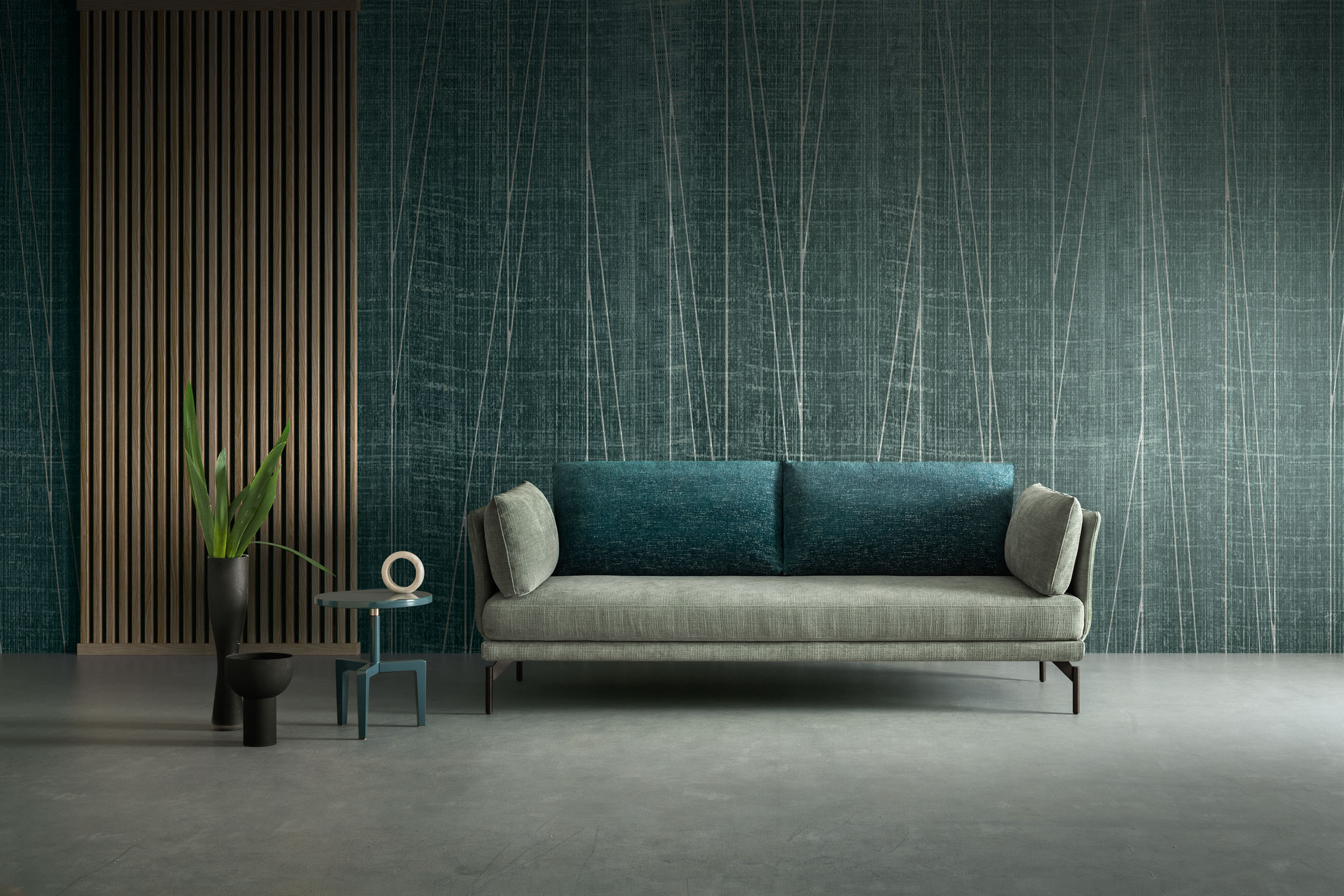
Isla sofa, with backrests and armrests that can be positioned as desired.
- Open Space or Integrated Living Areas. Here, the sofa often acts as a room divider rather than sitting against a wall. Modular configurations with chaise longue or peninsula elements help orient the relaxation area toward the TV while keeping all seats within a comfortable viewing angle.
- Natural Light. A window located in front of the screen—or behind the viewer—can cause glare that impairs visibility, regardless of distance. In such cases, the first step is to block out the light with blackout curtains. If that’s not possible, increasing the screen brightness helps compensate for glare, much like smartphones do in bright conditions.
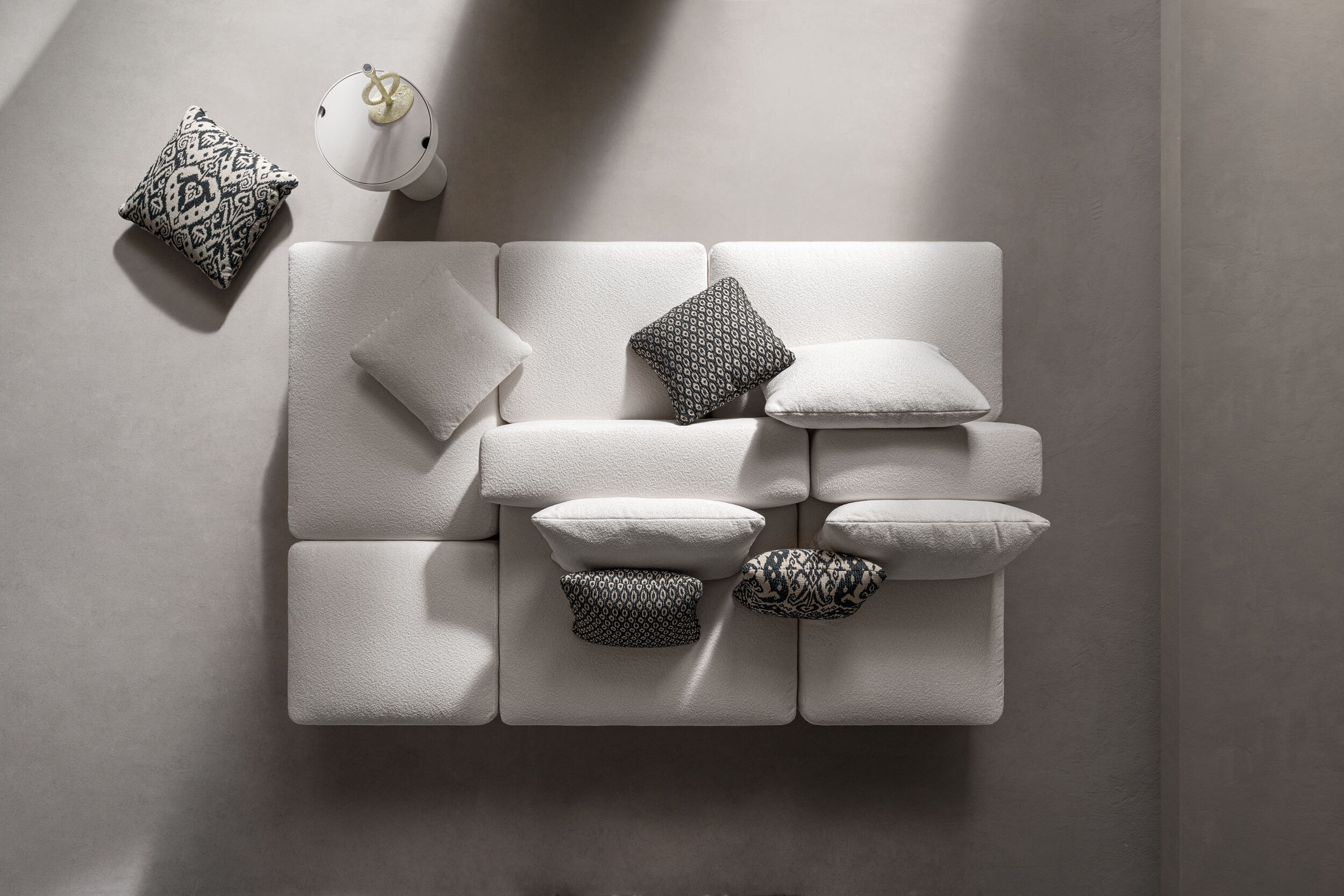
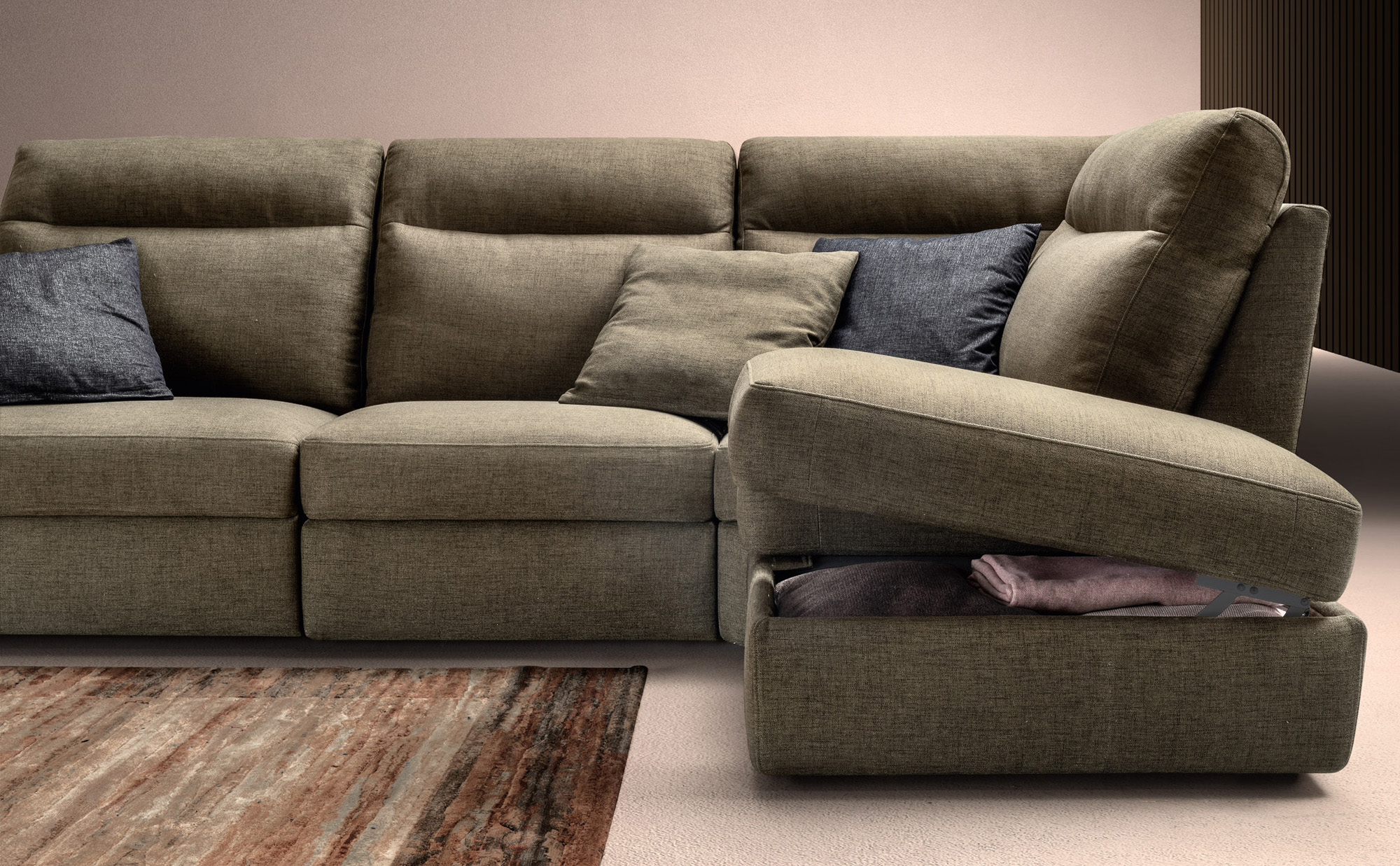
Sassy sofa, with movable modules and pouf and optional backrest package.
The 20-20-20 rule: a practical tip
Regardless of distance, prolonged TV viewing can strain the eyes. The Canadian Association of Optometrists recommends the 20-20-20 rule: every 20 minutes, focus for at least 20 seconds on an object at least 20 feet (6 meters) away. (Source: Canadian Association of Optometrists, “Digital Devices and Your Eyes”). Comfort on the sofa, correct posture, and optimal distance are interrelated factors that can be carefully designed to make every moment of relaxation truly enjoyable.
Sofa-TV distance: Samoa’s answers
Which sofa is best for frequent TV watching?
The key factor is not seat depth, but the backrest position, as it determines where your head is relative to the screen. Sofas with adjustable backrests from the Divine collection – such as Astor, Pull, and Sound Fly – allow you to move closer or farther from the TV simply by adjusting the backrest, without changing your room layout. For those seeking a relaxation system, Space Action (Relax collection) offers adjustable headrests and reclining mechanisms for long viewing sessions. Swing Slick, also in the Relax collection, adds a 103 cm high enveloping backrest that supports the head and neck.
Is a corner sofa better than a linear sofa for watching TV?
For group viewing, corner configurations help keep all seats within an acceptable viewing angle (ideally within 30–40° from the center of the screen). For individuals or couples, a well-positioned linear sofa works equally well. Divine collection models can be configured either way, while Sassy and Isla (Experience collection) allow easy reconfiguration over time.
Do extendable seats affect sofa–TV distance?
Not directly. When leaning against the backrest, extending the seat forward does not change your body or head position relative to the screen. Extendable seats improve comfort, but the actual viewing distance depends on the backrest position, not the seat. To effectively adjust your distance from the screen while seated, the models with sliding backrests in the Divine collection are the most effective solution.
How do you choose the right sofa configuration?
Key factors include room layout, TV position, natural light, viewing habits, and the number of people using the space. Bringing even a rough floor plan to an authorized Samoa retailer helps identify the most suitable model and configuration – both in terms of space and visual comfort during TV viewing.